How to Build a Balanced Breakfast (Without Overthinking It)
How to Build a Balanced Breakfast (Without Overthinking It)
I get some version of the same question almost every week: "What should I actually eat for breakfast?" People expect a specific answer — a meal plan, a list of foods, a formula with grams attached to it. What I usually give them instead is a way of thinking about the plate. That tends to be more useful, because it's something you can use every morning for the rest of your life, not just until you get tired of counting something.
Here's the short version: a balanced breakfast usually has three things on it — protein, fiber, and some fat. You don't need all three in exact amounts. You just need to notice when one of them is missing.
Why protein matters first
If your usual breakfast is a pastry, a bowl of low-protein cereal, or just coffee, the biggest single upgrade you can make is adding protein. It's the nutrient most breakfasts are shortest on, and it's the one that does the most to keep you steady until lunch — less of the mid-morning crash, less digging through the office snack drawer at 10:30.
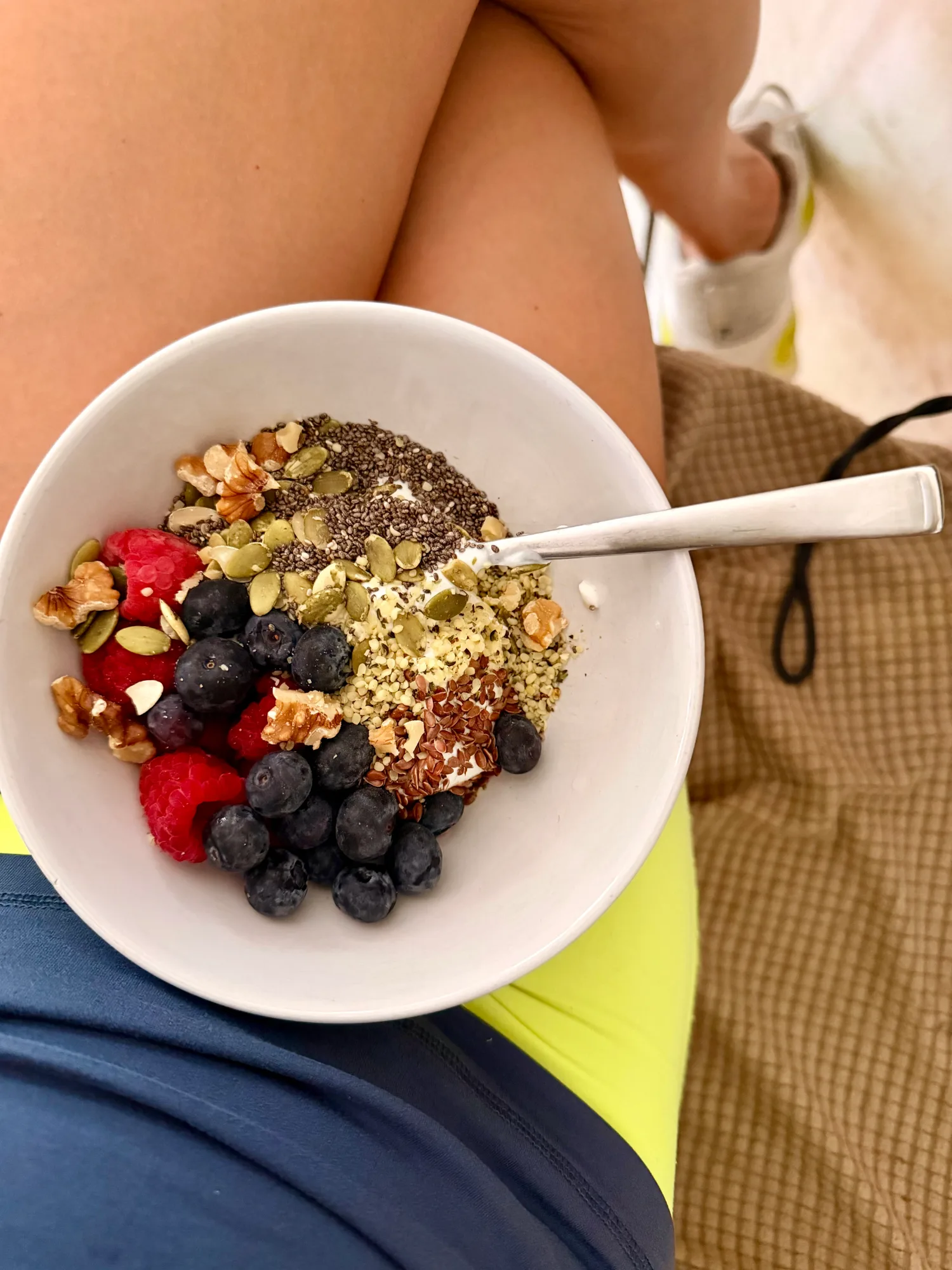
That doesn't mean a huge portion. A bowl of plain or lightly sweetened yogurt, a couple of eggs, cottage cheese, or a scoop of protein powder blended into a smoothie all get you there. I keep yogurt with berries in rotation myself for exactly this reason — it's fast, and it covers protein without any real prep.
Fiber is what keeps it from wearing off fast
Protein alone still leaves a gap. Pair it with something that has fiber — berries, a piece of fruit, oats, or a slice of whole-grain toast — and the meal holds longer. Fiber slows down how quickly the meal digests, which is a big part of why a plain bagel and a bagel with berries and yogurt on the side feel so different by 11am.
Fat rounds it out
A small amount of fat — nut butter, avocado, a drizzle of olive oil, whole milk yogurt instead of nonfat — adds staying power and makes the meal more satisfying. This is often the piece people skip because they've heard fat is something to minimize. It doesn't need to be minimized at breakfast. It needs to be present in a reasonable amount.
What this looks like in practice
You don't need a recipe for this. A few examples of what "protein plus fiber plus fat" looks like on an actual plate:
- Greek yogurt with berries and a spoon of nut butter
- Two eggs with avocado on whole-grain toast
- Cottage cheese with fruit and a handful of granola
- A smoothie with protein powder, frozen fruit, and a spoon of nut butter
None of these require a scale. They just need the three pieces present in some form.
If breakfast isn't something you usually eat
Some people genuinely aren't hungry in the morning, and that's fine — there's no rule that says everyone has to eat breakfast at 7am. What I'd gently push back on is skipping it because there wasn't time to make anything "proper." That's a solvable problem, and usually the solution is lowering the bar, not raising it. Yogurt and berries in a to-go container is still breakfast.
The takeaway
You don't need a meal plan to eat a good breakfast. You need a habit of checking for three things — protein, fiber, fat — and building from whatever you already like to eat. Start there, and the rest tends to sort itself out.
If you want a closer look at what a balanced routine could look like for you specifically, that's exactly what the Core Connection Call is for. It's free, and it's a chance to talk through where you're starting from and what would actually help. Virtual counseling is available where state law permits it, and we'll confirm that together before we get started.
This article is for general education and is not individualized medical or nutrition advice. Virtual nutrition counseling is available where permitted by applicable state law.